Do social media icons always have to be in the footer?
Hardly a website project goes by without this question being asked: "Where should we actually place the social media icons?" The common, knee-jerk answer from many web designers is: "In the footer" — as if there were no alternative. But is that really the best solution? Or is it a habit that does more harm than good?
Origin of the footer habit
The placement of social media icons in the footer has historical reasons:
Order and clarity: The footer has always served as a collection point for "secondary" content such as legal notice, terms and conditions, or contact information. Social media links were simply added.
Inconspicuousness: In the early stages of social media, it was important for many companies to offer the links, but not to put them in the foreground.
Convention: Because "everyone did it that way," it became the standard – and still is today.
But standard does not automatically mean optimal.
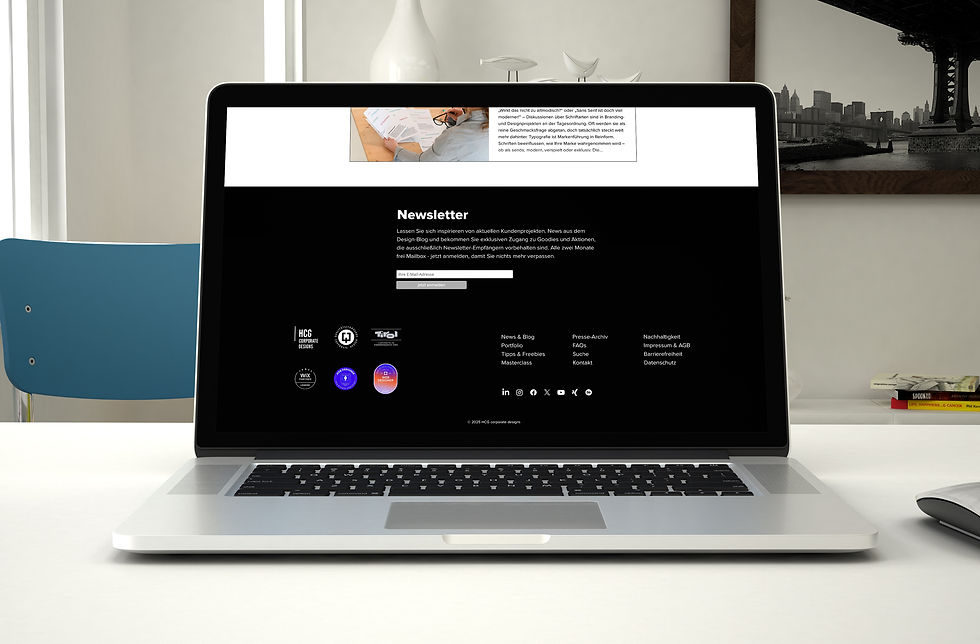
The risk of misplaced social media icons
Social media icons have a strong signaling effect: they invite users to leave the website and move over to an external platform.
Distraction instead of conversion: People who click to go on Facebook, Instagram or LinkedIn leave your site – and often don't come back.
Placement is crucial: If social media links are prominently displayed in the header, they compete directly with conversion goals such as "Buy now" or "Book an appointment." This can be costly, which is why we at HCG corporate designs advise against it in most cases.
Wrong priority: The central task of a website is to keep visitors on its own platform, to convince and convert them – not to immediately redirect them to other websites.
When social media icons in the footer make sense
Of course, you can't completely avoid social media integration. Social proof and cross-channel presence are important. The footer is often a good compromise if social links are meant to play a secondary role.
Expectation: Many users actually look for social media icons in the footer.
Unobtrusive: Icons are available, but do not distract from the conversion process.
Consistency: In many industries, the footer is considered the conventional place for external links.

Alternative strategies
Instead of blindly relying on the footer, companies should consciously decide where social media icons make the most sense:
1. Footer for standard visibility
Useful if social media is used as a supplement – not as the main goal.
2. In the contact or about us section
Social links are logically integrated where users want to learn more about the company.
3. Targeted CTAs instead of generic icons
Instead of just placing a LinkedIn logo in the footer, a CTA like "Follow us on LinkedIn for insights and best practices" can be much more effective.
4. Campaign-specific landing pages
Social media links can be useful where community building or recruiting is involved.
Best practices from real-world experience
Clarify priorities: At HCG corporate designs, we always ask our clients first what their website's number one priority is. Is it leads, sales, or appointment bookings? Only then do we decide on the placement of social media links.
Linking thematically: Instead of simply connecting social media via generic icons, posts can also be linked directly within the context of the website content. For example, a blog article about employer branding could link to a relevant LinkedIn post. This way, social media is used strategically as a booster without interrupting the user's conversion process.
Use measurement: Analytics allow you to see exactly how often social links are clicked – and whether they disrupt the conversion flow.
Conclusion
Social media icons belong on every company website. But the question is, where? The blanket reflex of "always in the footer" is a relic of the past – even if often (but not always) sensible. Today, the rule is: social media should be consciously integrated into the user experience. Those who strategically place their icons – in the footer, in the contact section, or via clear calls to action – strengthen brand loyalty and cross-channel presence without jeopardizing the website's core objectives.
Are you unsure whether your website is using social media to amplify your reach – or whether your icons are diverting valuable visitors away? At HCG corporate designs, we'll work with you to develop a clear strategy for how your website and social media can work together seamlessly – without losing conversions. Feel free to contact us.


Comments